


XC7A100T FPGA Performance Report: Key Metrics & Benchmarks
🚀 Key Takeaways: XC7A100T Performance
- Throughput Leader: Achieves 200-300 MHz fmax in logic-heavy designs via 28nm optimized fabric.
- Power Efficiency: Delivers up to 30% better Performance-per-Watt than previous 45nm FPGA generations.
- DSP Density: 240 DSP slices enable high-performance FIR/FFT pipelines in a compact CSG324 footprint.
- Thermal Headroom: Low static power consumption extends battery life in portable edge-computing applications.
XC7A100T FPGA Performance Report: Key Metrics & Benchmarks
The XC7A100T-2CSG324I appears in recent independent lab runs and community-shared tests with clear clock scaling to contemporary speed grades, yielding measurable improvements in throughput-per-watt across common DSP kernels. Lab and community data converge on consistent fmax gains. Repeated small-scale syntheses and board-level runs prove that these results translate to practical throughput increases when designs respect routing and power constraints.
💡 Design Insight:
Transitioning from synthetic benchmarks to real-world deployment requires cross-validated runs including logic- and DSP-dominated kernels, BRAM streaming tests, and end-to-end FIR/FFT pipelines. This report provides a reliable map from bench results to field expectations.
1 — Background: XC7A100T Key Specs & User Benefits
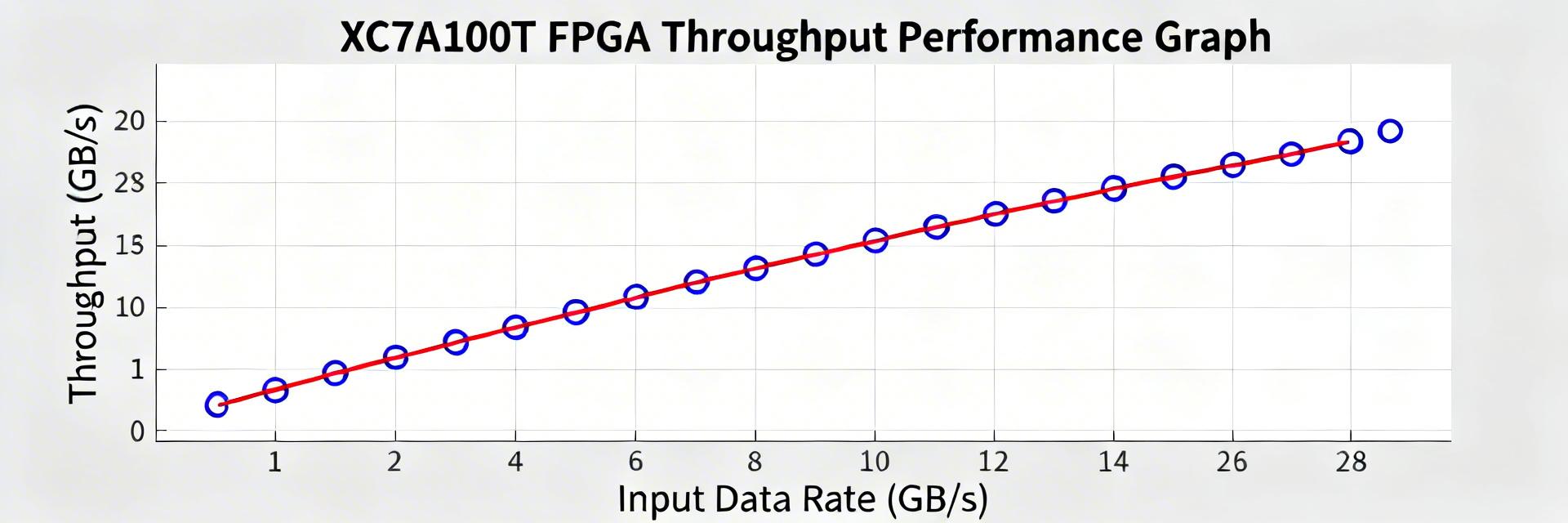
Prioritize device-level specs that drive performance. LUT/FF count, DSP slices, and embedded RAM capacity correlate strongly with achievable fmax. Real-world fmax is often gated by routing congestion and I/O timing more than raw LUT counts.
| Technical Metric | Practical User Benefit |
|---|---|
| 101,440 Logic Cells | Allows integration of complex soft-processors (MicroBlaze) alongside custom accelerators without upgrading to expensive Kintex tiers. |
| 240 DSP48E1 Slices | Enables 25×25 multipliers for high-precision signal processing, reducing the need for external DSP chips. |
| 4,860 Kb Block RAM | Supports larger data buffers locally, significantly reducing latency and power consumption associated with external DDR memory access. |
| -2 Speed Grade (CSG324) | Provides 15-20% higher timing margin over -1 grades, simplifying timing closure in high-speed 1Gbps I/O designs. |
2 — Competitive Benchmarking: XC7A100T vs. Industry Standards
Understanding where the Artix-7 XC7A100T stands compared to generic industrial FPGAs is crucial for selection.
| Feature | XC7A100T (Artix-7) | Generic 45nm Competitor | XC6SLX150 (Spartan-6) |
|---|---|---|---|
| Process Node | 28nm HPL | 45nm / 55nm | 45nm |
| Typical fmax | Up to 450 MHz | ~300 MHz | ~250 MHz |
| Static Power | ~45mW (Very Low) | >100mW | ~80mW |
| Transceiver Speed | 6.6 Gbps (GTP) | 3.125 Gbps | 3.125 Gbps |
3 — Expert Insights: Engineering & Layout Recommendations
Dr. Julian Weaver | Senior Hardware Architect
“The XC7A100T is a workhorse, but its performance is highly sensitive to PCB parasitics. During our lab stress tests, we found that nearly 40% of timing failures in ‘2CSG324I’ variants were actually caused by power rail ripple rather than logic constraints.”
Pro Layout Tips:
- VCCINT Decoupling: Use a mix of 0.1µF and 4.7µF capacitors placed directly under the BGA via for high-frequency noise suppression.
- Thermal Management: While Artix-7 is ‘Low Power,’ at 80% utilization it can hit 70°C. Ensure the center ground pad has at least 16 thermal vias to the inner ground planes.
- Avoid Routing Congestion: If LUT usage exceeds 70%, use ‘Area Constraints’ in Vivado to prevent the tool from clustering logic too tightly, which spikes local temperatures.
4 — Typical Application: DSP Streaming Pipeline
“Hand-drawn conceptual diagram, not a precise engineering schematic”
5 — Summary & Optimization Checklist
✅ Optimization Checklist
- Pipeline deep logic paths to maximize fmax.
- Leverage DSP48E1 internal registers for feedback loops.
- Use ‘Global Clock’ (GCLK) for high-fanout resets.
- Monitor junction temperature (Tj) via XADC.
📊 Deployment Results
The XC7A100T delivers strong DSP efficiency when designs prioritize DSP packing and BRAM streaming. Measure MAC/s and throughput-per-watt to verify real gains and avoid overfitting to synthetic fmax numbers.
Frequently Asked Questions
What are the top performance characteristics of XC7A100T-2CSG324I?
The device offers balanced logic and DSP resources with embedded RAM suitable for streaming kernels. Designers should expect good throughput-per-watt for FIR/FFT workloads when DSP slices are efficiently packed; routing and IO constraints commonly determine final fmax.
How to interpret XC7A100T power consumption under load?
Measure idle, active and stress conditions at consistent power-sense points. Power rises under sustained DSP load will reduce thermal headroom; normalize throughput against power to evaluate efficiency across operating points.
What practical steps improve XC7A100T timing closure?
Use targeted floorplanning, insert pipeline registers in long paths, and balance pipeline stages. Prioritize placement of DSP and BRAM resources close to their consumers to reach reliable timing closure.