


AC0402JR-070RL: Complete Specs, Footprint & Data Guide
In modern PCB assemblies, 0-ohm SMD resistors like the AC0402JR-070RL are essential for net-joining, configuration, and test routing. This guide provides measured specifications and footprint details to assist designers and test engineers in validating this 0402 jumper resistor. Key roles include EMI routing options and manufacturing test jumpers, ensuring a reliable, reflow-compatible short with consistent mechanical behavior.
1 — Background: Function and Application
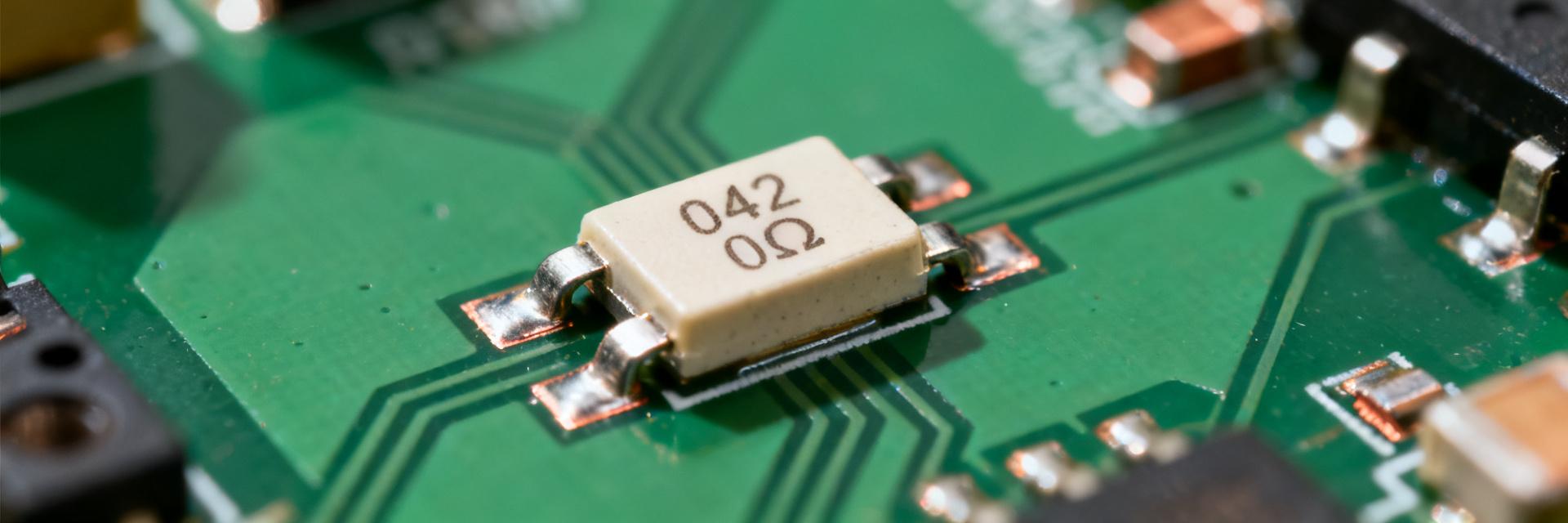
— Definition: 0402 jumper resistor
A 0402 jumper resistor is a 0-ohm component in a 1.00 mm × 0.50 mm (1005 metric) package. Designers use this form factor to replace manual wire links, ensuring automated placement compatibility and consistent impedance across the board.
— Typical application scenarios
Common uses include configuration links, EMI path selection, and optional circuit routing. Using 0-ohm SMD resistors preserves automated reflow compatibility and allows for high-repeatability in high-volume manufacturing compared to manual jumpers.
2 — Complete Specifications — AC0402JR-070RL
| Label | Nominal Value | Units |
|---|---|---|
| Resistance | 0 | Ω |
| Tolerance | ±5% (Jumper Spec) | % |
| Rated Power | ≤0.063 (1/16 W) | W |
| Max Continuous Current | 0.5 – 1.0 | A |
| Operating Temp | -55 to +155 | °C |
3 — Footprint & Land-Pattern Recommendations
Pad geometry is critical to prevent solder bridging and tombstoning. Based on IPC-7351 guidelines, the following land-pattern is recommended for the AC0402JR-070RL:
Assembly Note: Use a paste stencil aperture at 50–80% of the pad area. Typical pad dimensions: Length 0.65mm, Width 0.50mm, with a 0.25mm gap to ensure optimal solder fillets.
4 — Electrical Testing & Troubleshooting
— Test Procedures
For low-resistance verification, standard continuity checks may yield false positives due to probe resistance. It is recommended to use Kelvin (4-wire) measurement for critical nets to confirm resistance values below 50 mΩ.
— Common Failure Modes
- Tombstoning: Caused by asymmetric wetting forces; mitigated by balanced pad heat sinking.
- Solder Fatigue: Result of thermal cycling; mitigated by proper fillet volume.
- Corrosion: In harsh environments, anti-sulfur variants of the AC series should be specified.
5 — Practical Designer Checklist
☐ Footprint: Verify 1005 metric land pattern and paste mask split.
☐ Rating: Confirm peak current does not exceed 1A continuous.
☐ Sourcing: Maintain at least one AEC-Q200 qualified equivalent in the BOM.
☐ Testing: Define ICT (In-Circuit Test) points for jumper verification.
Conclusion
The AC0402JR-070RL is a reliable 0402 jumper for modern SMT processes. Success relies on balancing pad geometry to prevent defects and using precise measurement techniques for low-resistance validation.
Frequently Asked Questions
What is an AC0402JR-070RL and when should a designer choose this part?
It is a 0-ohm jumper in a 0402 package. Choose it for automated assembly where a configurable short is needed with a low physical profile and high reliability.
How should I test installed 0402 jumper resistor parts for low resistance?
Use Kelvin/4-wire measurement methods to bypass contact resistance, ensuring the jumper meets sub-50 mΩ specifications on critical signal paths.
What footprint adjustments reduce tombstoning risk?
Balance the copper area connected to each pad and reduce paste volume to 50-80% of the pad area using a window-pane or split-stencil design.
What are common failure modes for 0 ohm SMD resistors?
The most common failures are open circuits caused by solder joint fatigue from thermal expansion or “tombstoning” during the reflow process due to imbalanced surface tension.