


L8050QLT1G datasheet: Complete Specs & Pinout Summary
L8050QLT1G datasheet: Complete Specs & Pinout Summary
The L8050QLT1G is a compact SOT-23 NPN transistor rated for roughly 0.8 A continuous collector current and a 25 V collector-emitter voltage, making it a common choice for low-voltage switching and small-signal amplification. This article condenses the complete L8050QLT1G datasheet into an easy-reference specs and pinout summary so engineers can quickly find ratings, pin mapping, thermal guidance, and concise application examples.
Values and test conditions below are drawn from published device specifications; designers should verify absolute limits and footprint drawings in the official L8050QLT1G datasheet PDF before production. This two-page summary prioritizes fast decisions and safe design margins for US hardware teams.
1 — Quick Product Overview (background)
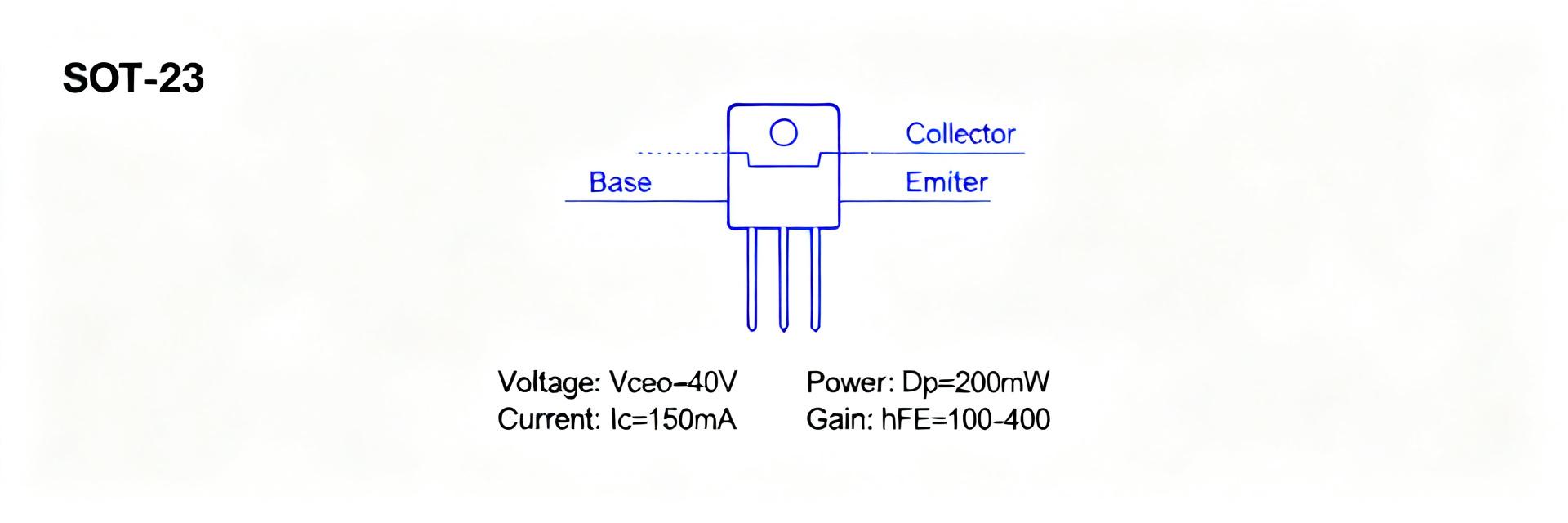
Point: The L8050QLT1G targets low-voltage switching and small-signal tasks in compact assemblies. Evidence: The device is supplied in SOT-23 with a conservative VCEO ≈ 25 V and Ic ≈ 0.8 A. Explanation: Its package and ratings favor signal drivers, LED switches, and small relay drivers where board area and low-cost assembly matter.
Key highlights & intended uses
- Package: SOT-23 surface-mount; typical continuous collector current ≈ 0.8 A; VCEO ≈ 25 V; operating range includes -55 °C to +150 °C (verify in datasheet).
- Common applications: low-voltage DC switching for LEDs and small loads; driver stage for MOSFET gates or relays; small-signal amplification in portable systems.
- Use-case examples: LED low-side switch with base resistor, small relay driver with flyback protection, single-stage amplifier in sensor front-end.
How this summary maps to the full datasheet
Point: This summary extracts maximum ratings, electrical characteristics, pinout, mechanical drawing, thermal data, and simple circuits. Evidence: Each numerical item references device test conditions where available and flags items for verification. Explanation: Use this document for quick evaluation and then consult the original PDF for guaranteed limits, waveform graphs, and package marking details before committing to production.
2 — Complete Electrical Specifications (data analysis)
Point: Key electrical specs determine suitability for switching vs. analog use; consult the datasheet for test conditions. Evidence: Representative values shown below reflect common published figures (verify in original datasheet). Explanation: Designers should check hFE ranges at intended Ic and VCE, and pay attention to VCE(sat) under base drive used in the final circuit.
Maximum ratings (table format)
| Parameter | Symbol | Condition | Typ/Max | Unit | Notes |
|---|---|---|---|---|---|
| Collector-Emitter Voltage | VCEO | IB=0 | 25 | V | Verify in datasheet |
| Collector Current (continuous) | IC | Ta=25°C | ≈0.8 | A | Pulse ratings higher |
| Power Dissipation (SOT-23) | Pd | Ta=25°C | see datasheet | W | Board dependent |
| Junction Temperature | Tj(max) | – | ≤150 | °C | Verify in datasheet |
DC and AC characteristics (table + interpretation)
| Parameter | Condition | Min | Typ | Max | Unit |
|---|---|---|---|---|---|
| DC current gain | Ic=50mA, VCE=1V | — | varies | — | hFE |
| VCE(sat) | Ic=100mA, IB=10mA | — | low | — | V |
| Leakage current | VCE=20V | — | µA level | — | A |
Point: Interpret parameters for the intended mode: switching favors low VCE(sat) at given IB, analog favors stable hFE across Ic. Evidence: hFE can vary widely between devices and batches. Explanation: When designing, budget base drive assuming worst-case low hFE or measure a batch and set bias networks accordingly.
3 — Pinout & Package Details (data analysis / pinout)
H3 Pin mapping & orientation (visual description)
Point: The SOT-23 pin mapping must be confirmed per part marking. Evidence: Typical mapping is Pin 1 = Base, Pin 2 = Emitter, Pin 3 = Collector (confirm in datasheet). Explanation: On PCB, orient the package so the flat edge or marking dot matches the datasheet view; double-check part marking codes before layout.
Mechanical dimensions & PCB footprint recommendations
Point: Use the mechanical drawing to create a recommended land pattern with correct pad sizes and courtyard. Evidence: Datasheet includes mm and inch values for body and lead length—use those for precise solder fillet control. Explanation: Add a small thermal relief to the collector pad if repeated high-current switching is expected and include silkscreen reference for assembly verification.
Typical SOT-23 view (top): Pin1 (B) — Pin2 (E) — Pin3 (C)
4 — Thermal & Reliability Characteristics (method/guides)
H3 Thermal resistance & power dissipation guidance
Point: θJA and θJC set allowable continuous power. Evidence: Datasheet lists thermal resistances; use Pd = (Tj_max − Ta) / θJA as baseline. Explanation: Example: if θJA = X °C/W and Tj_max = 150 °C, then allowed Pd at Ta=25 °C = (150−25)/θJA. Always add margin and derate per °C above 25 °C as specified.
Safe operating area & max junction temp considerations
Point: Sustained currents near 0.8 A require PCB thermal planning. Evidence: SOT-23 limits heat dissipation compared with larger packages. Explanation: Keep continuous current below ~50–70% of Ic_max on a typical 1–2 layer board unless thermal vias or copper pours are used to spread heat; verify with thermal rise testing under expected duty cycle.
5 — Typical Applications & Design Examples (case study)
Switching example (practical circuit)
Point: For a low-side switch targeting Ic=200 mA, choose base current IB = Ic/10 = 20 mA for reliable saturation. Evidence: If hFE in saturation is ~10, IB=20 mA yields VCE(sat) under typical datasheet conditions. Explanation: With Vdrive=5V and Vbe≈0.7V, Rb ≈ (5−0.7)/20mA ≈ 215 Ω; use 220 Ω and add a base-emitter bleed resistor (100 kΩ) to prevent latch when input floating and include a flyback diode for inductive loads.
Small-signal amplifier / biasing example
Point: For a common-emitter amplifier aiming moderate gain, bias to Ic=1–10 mA depending on required headroom. Evidence: hFE spread impacts gain; datasheet hFE vs Ic curves guide resistor choices. Explanation: Use Vcc/2 collector bias and choose emitter resistor for stability; measure sample hFE and adjust base bias network to center Q-point and allow ±Vce swing.
6 — PCB Layout, Testing & Sourcing Checklist (action)
H3 PCB layout & assembly notes
Point: Place transistor close to the load and route collector traces with adequate copper. Evidence: Thermal dissipation improves with larger copper areas and vias. Explanation: Use solder paste recommended profile for SOT-23, follow ESD handling, and place decoupling capacitors close to switching nodes to minimize inductance.
Bench testing and verification steps
Point: Implement a short test plan before full production. Evidence: Basic checks include pin continuity, hFE sampling across 10–20 units, VCE(sat) under expected IB, and thermal rise under load. Explanation: Document pass/fail criteria (e.g., ΔT
Key summary
- The L8050QLT1G datasheet shows a SOT-23 NPN transistor suited for low-voltage switching and small-signal tasks; verify VCEO ≈ 25 V and Ic ≈ 0.8 A in the official PDF before use.
- Designers should prioritize VCE(sat) and hFE under their intended Ic when sizing base drive and bias networks; assume conservative hFE for saturation calculations and include protection like flyback diodes.
- Thermal planning is critical: use θJA from the datasheet to calculate Pd and derate for ambient temperature; add copper pours or thermal vias for sustained currents above modest fractions of Ic_max.
Frequently Asked Questions
What is the L8050QLT1G pinout for PCB layout?
Typical SOT-23 pin mapping is Pin 1 = Base, Pin 2 = Emitter, Pin 3 = Collector (top view). Always confirm this mapping on the device marking and the official datasheet PDF before finalizing the PCB footprint and silk layer.
What are the key L8050QLT1G specs to check before sourcing?
Verify VCEO, maximum continuous IC, Pd (package-limited), θJA, and Tj(max) on the datasheet. Also confirm part marking, package code, and RoHS/lead-free status. Use sample testing to validate hFE distribution for your production lot.
How should I test VCE(sat) and thermal rise on the bench?
Measure VCE(sat) with specified Ic and IB values from the datasheet, then apply sustained current while logging junction or case temperature with a thermocouple. Acceptable thermal rise depends on your Pd calculation and the margin you set against Tj(max).
Summary
This L8050QLT1G datasheet summary condenses the transistor’s core specs, pinout orientation, thermal guidance, and practical circuits so designers can quickly evaluate suitability for low-voltage switching and small-signal applications. Verify all numerical limits and package drawings in the official datasheet prior to layout and procurement.