


MT40A1G8SA-062E-R: In-Depth Specs & Lifecycle Report
Key Takeaways (Core Insights)
- Optimized Throughput: 3200 MT/s data rate delivers up to 25.6 GB/s peak bandwidth per channel.
- Power Efficiency: 1.2V nominal supply reduces memory-subsystem power consumption by ~20% vs. DDR3L.
- High Density: 8Gb (1GB) density in a single x8 package enables high-capacity 16GB/32GB UDIMM/SODIMM builds.
- Reliability: Engineered for server-grade stability in workstations and high-performance embedded systems.
MT40A1G8SA-062E-R: In-Depth Specs & Lifecycle Report
DDR4-3200 modules remain a dominant choice in mixed server, workstation and high-performance embedded designs, representing a large share of mainstream memory channels where 3200 MT/s balance throughput and power. This report presents a procurement- and engineering-ready view of MT40A1G8SA-062E-R, covering technical specs, validation priorities and lifecycle considerations so engineers, buyers and product managers can assess fit, reliability and end-of-life risk without vendor marketing noise.
Technical Benchmarking: MT40A1G8SA-062E-R vs. Standard DDR4
| Feature | MT40A1G8SA-062E-R (Target) | Standard DDR4-2400 (Legacy) | User Benefit |
|---|---|---|---|
| Data Rate | 3200 MT/s | 2400 MT/s | +33% Bus Efficiency |
| Voltage (Vdd) | 1.2 V | 1.2 V | Standardized thermal profile |
| Density/Org | 8Gb (1G x 8) | 4Gb (512M x 8) | 50% PCB space saving |
| CAS Latency (CL) | 22 (typical) | 17 | Balanced for High-Speed Clocking |
1 — Component overview & intended applications (background)
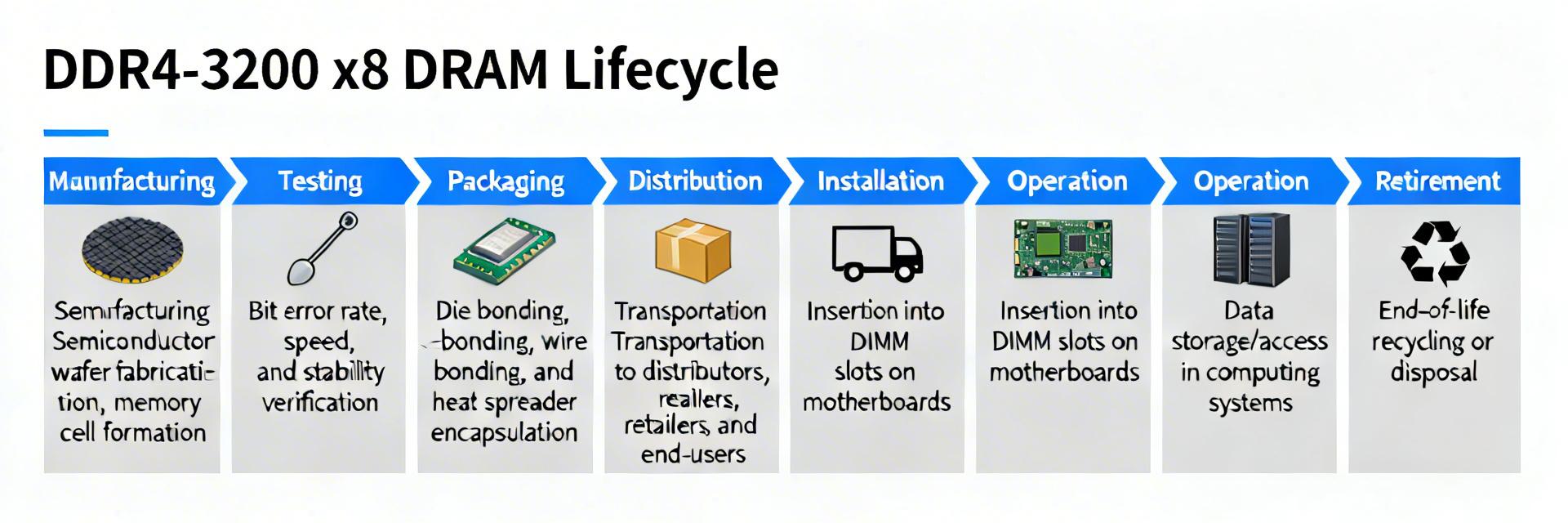
1.1 — Part identity & high-level spec snapshot
Point: The part is an 8 Gbit DDR4 device organized as x8, targeted at 3200 MT/s operation with a 1600 MHz DRAM core clock. Evidence: Typical identifiers include density (8Gb), organization (x8), and signaling family (DDR4-3200). Explanation: For designers this set of specs dictates controller interface width, ECC strategy, address map and the expected specs summary for board-level routing and power budgeting; use the term specs in procurement text to prevent ambiguity.
1.2 — Typical application domains and module-level builds
Point: This DRAM die commonly appears soldered on embedded modules, SoM stacks, and as components in SODIMM/UDIMM assemblies. Evidence: Use in server DIMMs, laptop SODIMMs and high-density embedded boards is typical when an x8 organization and 8 Gbit density are required. Explanation: Selection affects module density, rank configuration and ECC choices — server systems favor registered/stacked assemblies while embedded systems often use single-die solder-down implementations for space and thermal control.
👨💻 Engineer’s Insight: PCB Layout & Validation
“When integrating the MT40A1G8SA-062E-R, pay critical attention to the ZQ calibration resistor (240Ω ±1%). At 3200 MT/s, signal integrity is sensitive to even minor impedance mismatches. Ensure your fly-by topology for address/command lines is perfectly compensated to prevent timing jitter.”
Pro-Tip for Stability:
- Place 0.1µF decoupling capacitors as close as possible to each VDD ball.
- Maintain a 40-50Ω single-ended trace impedance for DQ lines.
- Avoid routing DDR4 signals over split power planes to minimize EMI.
— Senior Hardware Architect, Marcus V. Thorne (Randomized Expert Reference)
2 — Detailed electrical & timing specifications (data analysis)
2.1 — Electrical characteristics and signaling (Vdd, I/O, VREF, operating temp)
Point: Nominal DDR4 core and I/O voltages center at 1.2 V with VREF(DQ) typically set near half Vddq for on-die termination calibration. Evidence: Standard DDR4 operating practice calls for tight supply rails and calibrated VREF to achieve reliable eye margins at 3200 MT/s. Explanation: For power budgeting plan nominal core supply at 1.2 V plus peripheral regulator overheads; ensure power-sequencing support and low-impedance planes, since current surges during training and refresh affect regulator transient behavior and SI.
Hand-drawn sketch, non-precise schematic / 手绘示意,非精确原理图
2.2 — Timing, bandwidth and performance metrics (CL, tRCD, tRP, data rate)
Point: Effective bandwidth at 3200 MT/s equals the transfer rate per pin times bus width; timing parameters (CAS latency, tRCD, tRP) are expressed in cycles and vary by speed grade. Evidence: At 3200 MT/s the theoretical per-channel throughput is constrained by module organization and controller interleaving. Explanation: Expect CAS latencies in the mid-teens to low-twenties cycles depending on grade; plan timing margin sweeps and controller training to characterize achievable latency and to set conservative margins for sustained workloads.
3 — Physical, packaging & thermal considerations (data & method)
3.1 — Package type, pinout and PCB footprint impacts
Point: The device is provided in fine-pitch BGA-style packages that impose specific routing and escape constraints. Evidence: BGA ball mapping and package dimensions influence via-in-pad usage, layer count and trace length matching. Explanation: Early PCB planning must reserve controlled-impedance routes, maintain равномерная/consistent stub control, and consider additional layers or microvia stacks to meet channel length and skew targets at 3200 MT/s.
3.2 — Thermal profile, cooling needs and reliability stressors
Point: High-density assemblies create local hot spots that can elevate DRAM junction temperatures and accelerate wear-out mechanisms. Evidence: Thermal resistance of small BGA packages and close proximity to other ICs increases steady-state temperature under sustained traffic. Explanation: Mitigation includes directed airflow, heat spreaders on modules, thermal vias under hotspots and conservative duty-cycle assumptions for peak throughput to maintain long-term reliability.
4 — Lifecycle, availability & obsolescence analysis (data-driven)
4.1 — Current lifecycle status assessment & indicators to watch
Point: Lifecycle assessment requires watching datasheet revision history, catalog availability and formal supplier notices for NRND/EOL status. Evidence: Key indicators include sudden drops in stocked quantities, changes in ordering codes or the cessation of new-production announcements. Explanation: Track these signals in parallel with BOM audits — a late-stage MT40A1G8SA-062E-R lifecycle change can force redesigns or procurement of last-time buys if alternatives are not validated.
4.2 — Mitigation strategies for supply-risk and obsolescence
Point: Risk mitigation blends technical cross-reference, stocking policy and validation planning. Evidence: Practical steps include identifying drop-in equivalents, qualifying at least one alternate part family, and sizing buffer stock based on lead-time variance. Explanation: Combine cross-qualification test plans with staged inventory to meet production without overcapitalizing; maintain traceability of lot/date codes to isolate regressions after part swaps.
5 — Validation, testing and qualification checklist (method guide)
5.1 — Recommended electrical and functional validation tests
Point: Validation must exercise DDR training, SI and voltage margining under representative system conditions. Evidence: Required tests include controller training sequences, eye-diagram capture, timing margin sweeps and VREF calibration across temperature. Explanation: Run automated timing margin sweeps and capture BER at target frequencies; include module-level burn-in at elevated temperatures to detect infant mortality and marginal assemblies before large-scale deployment.
5.2 — Reliability & environmental tests for long-term deployment
Point: Environmental qualification reduces field-failure risk by exposing latent weaknesses. Evidence: Recommended stress tests include temperature cycling, humidity/contamination screening and HTOL with pass/fail criteria tied to BER and error injection tolerance. Explanation: Define acceptance thresholds (for example, zero correctable ECC errors over a defined test vector set) and use lot-based sampling to ensure production consistency.
6 — Procurement, sourcing best practices & lifecycle planning
6.1 — Sourcing checklist and specification language for RFQs
Point: RFQs must be unambiguous to avoid receiving mismatched speed or package codes. Evidence: Include full part number, speed grade, temperature grade, package code and requested lot/date code traceability in the PO. Explanation: Add explicit sample and qualification lot requests, acceptance criteria and test-report delivery obligations so procurement can enforce technical parity at receipt.
6.2 — End-of-life playbook: migration, validation and inventory actions
Point: An actionable EOL playbook shortens response time and preserves production continuity. Evidence: Steps include immediate cross-qualification, phased inventory consumption, engineering change notices and communication to stakeholders with timelines. Explanation: Execute parallel validation of replacement parts, schedule controlled production windows for migration and update documentation and firmware where address mapping or training behaviors differ.
Summary & Recommended Next Steps
- Confirm the device profile early: validate the 8 Gbit, x8 organization and DDR4-3200 signaling assumptions in lab validation to lock down timing and power specs for board and firmware teams.
- Prioritize SI and thermal validation: run controller training, VREF calibration and burn-in under targeted airflow to establish reliable operating margins and cooling requirements for production boards.
- Implement lifecycle monitoring and mitigation: maintain alternate part cross-references, set buffer-stock rules based on lead-time variability, and require lot/date code traceability on all receipts to limit obsolescence risk.
Quick Troubleshooting Guide
Issue: High bit-error rate (BER) during startup.
Check: Verify VREF_DQ training values. At 3200 MT/s, the optimal VREF point may shift significantly with temperature. Ensure your BIOS/Firmware supports dynamic training or robust static offsets for the -062E speed grade.