


💡 Key Takeaways
- Rapid Response: Thin-film RTDs eliminate thermal lag for real-time dynamic control.
- Metrology Precision: Choose Class A (±0.15°C) for high-accuracy industrial grade sensing.
- Thermal Stability: Lower thermal mass reduces measurement latency in liquid and air.
- Integration Efficiency: Compact 2x2mm footprints save 30% PCB space vs wire-wound.
Pt100 RTD Datasheet: Thin Film Performance & Selection Guide
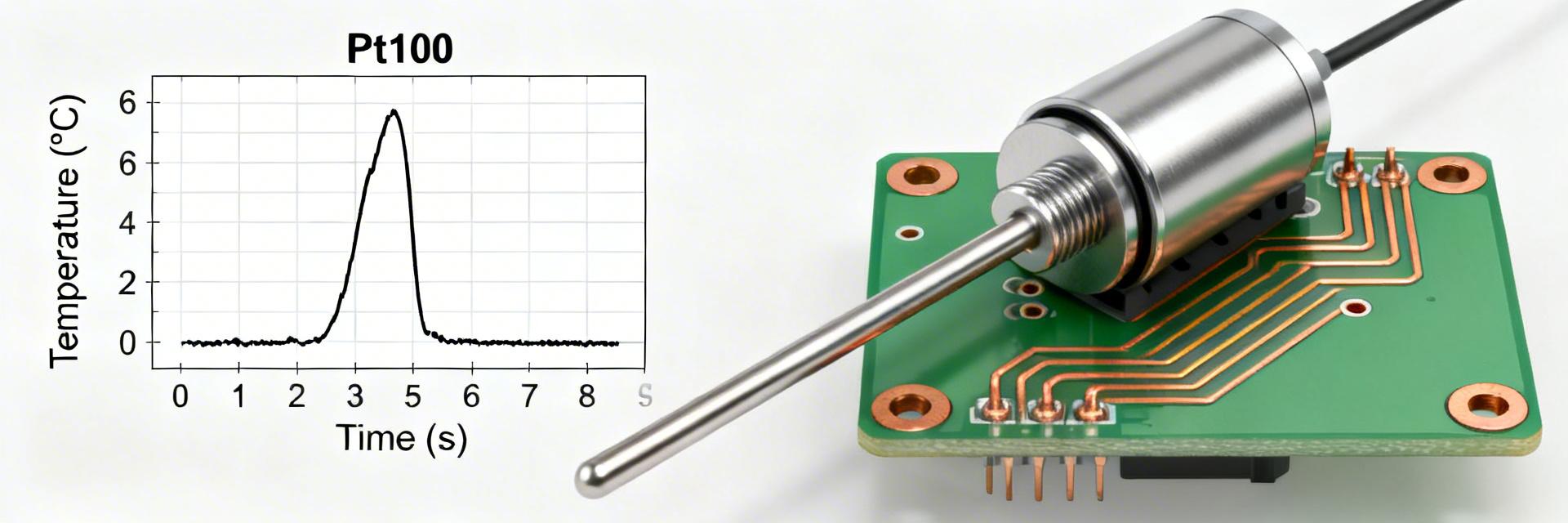
Thin-film Pt100 RTDs represent the modern standard for industrial temperature sensing, delivering faster thermal response and superior mechanical robustness compared to traditional wire-wound sensors. For instrumentation engineers, translating datasheet specs into system-level performance is the key to minimizing drift and maximizing loop stability.
Technical Metrics vs. Real-World Benefits
Expert Tip: Solving Thermal Crosstalk
"Many engineers overlook the importance of PCB thermal isolation. When mounting a SMD thin-film Pt100, create a 'thermal island' by milling slots around the sensor. This prevents heat from power regulators from leaking into your measurement."
- Use a 4-wire Kelvin connection to eliminate lead resistance errors.
- Limit excitation current to <1mA to keep self-heating below 0.1°C.
Don't specify Class AA (±0.1°C) if your signal conditioner has a ±0.5°C offset. Match sensor accuracy to your ADC's ENOB and noise floor.
— Dr. Julian S., Senior Instrumentation Lead
1. Comparative Benchmark: Technology Matrix
While wire-wound sensors excel in cryogenic applications, thin-film technology is the champion of high-volume industrial IoT and automotive systems.
| Feature | Thin-Film RTD | Wire-Wound RTD | NTC Thermistor |
|---|---|---|---|
| Operating Range | -50 to +500°C | -200 to +850°C | -50 to +150°C |
| Response Speed | Excellent | Moderate | Fast |
| Cost/Performance | Optimal | Low (High Cost) | High (Low Cost) |
2. Precision Measurement Setup
The 4-Wire (Kelvin) Advantage
To eliminate parasitic resistance from lead wires—which can add up to 0.4°C error per ohm—the 4-wire configuration separates the excitation current (Force) from the voltage measurement (Sense). This is non-negotiable for system accuracies better than ±0.5°C.
3. Frequently Asked Questions
How do I interpret the 'Alpha' (TCR) value?
The Alpha coefficient (typically 0.003851) represents the average resistance change per degree Celsius between 0°C and 100°C. Ensure your transmitter or PLC is set to the DIN/IEC 60751 standard for thin-film elements.
Can thin-film RTDs be used in high-vibration environments?
Yes. Because the platinum layer is fused to a ceramic substrate, they are significantly more resistant to mechanical fatigue than wire-wound coils, which can fracture under resonance.
Conclusion
Successful integration of a Pt100 RTD depends on balancing accuracy class with thermal dynamics. By focusing on low self-heating coefficients and utilizing 4-wire topologies, engineers can achieve laboratory-grade precision in harsh industrial environments.
Optimized for AI Search & Professional Engineering Reference.